Enter your assignment draft separated by a line and then the complete assignment after all revisions at the bottom of the page. Include word count for each in parenthesis beside the title.
For example
Draft 1 (500 words)
genre 1 (article)
genre 2 (poster)
Name: Nancy Paulino Ovalle
Assignment 3
English:101
Title: Better Sleep, Better Grades
College students love coffee so much it might as well be an elective, who needs eight hours of sleep when you’ve got eight cups of caffeine ,right?
Prioritizing sleep isn’t lazy, it’s essential for mental health, learning and overall well being. Getting enough sleep each night helps you manage stress, remember information better, and perform your best in school and in life.Despite this, many students struggle to get sufficient rest due to late night studying, irregular schedules, and social or work commitments.This article will explore will explore three key areas: The challenges college students face, Why sleep matters for mental health and Physical health, and the Practical strategies to improve sleep habits. By understanding these areas ,students can make better choices to prioritize rest and take care of their mind and body.
Challenges College Students Face
Many college students struggle to get enough sleep,even though they know its importance .late nights studying ,irregular class schedules, part-time jobs ,social activities all contribute to chronic sleep deprivation, Based on the findings of this study ‘’Daytime sleepiness ,sleep deprivation, and irregular sleep schedules are highly prevalent among college students ,consequences can result in lower grade point average, increased risk of academic failure,compromised learning, impaired mood and increased risk of motor vehicles accidents’’. This shows that sleep deprivation is not just a minor convenience, it is a serious challenge that affects a student’s academic performance, mental health and overall well-being.Understanding these challenges is the first step towards making sleep a better priority
Why sleep matters for mental health and physical health
Sleep is essential because it gives your mind and body the power to fully recharge ,when you get a good night sleep, you stay focused, think clearly and keep your emotions in control, as well as your body uses the time to repair it self, it strengthens it’s immune system giving it the energy you need for the following day, According to Matthew Walker a neuroscientist ,professor and sleep expert at the University of Berkeley in his TED talk “sleep is your superpower” he emphasized that getting enough sleep improve brain functions such as memory, learning ,and handling emotions, he explains that sleeping both before and after learning helps your brain take in new information and hold onto it ,which also helps keep stress, anxiety,and irritability down. He also talks about how sleep affects your body,pointing out that even one night of poor sleep can make your immune cell system weaker by up to 70% and raising the chance of heart problems. These results show that sleep isn’t optional, it’s something our bodies and mind truly need. When we don’t get enough sleep we become more stressed, less focused and more likely to get sick, but when we do make sleep a priority we think more clearly, feel emotionally better and stay healthier overall.
Practical strategies to improve sleep habits
Practical strategies give people actionable ways to prioritize sleep, which improves both mental and physical health. Quality rest isn’t just about how many hours you sleep, but how you live throughout the day .These are habits or routines that are easy to apply in daily life. The Los Angeles Times article ‘’The Sleep Reset :How to Hack Your Circadian Rhythm for Better Health’’ focuses on the everyday strategies that helps better sleep , it explains why so many adults struggle with poor rest and it highlights how habits like screen time, hormonal changes , stress and irregular routines that disrupts the body’s natural sleep rhythm or circadian rhythm ,this article recommends practical strategies such as :
- Keeping a consistent sleep schedule.
- Creating a calming routine (meditating )
- Limiting Caffeine !!!
- Screen Time before bed
- Optimizing your bedroom environment (making your room as sleep friendly as possible so it’s easier for your body and mind to relax)
- Getting Morning Sunlight
- Managing stress
- Exercise
It emphasizes that better sleep comes from simple every day actions and a routine that supports your body’s natural sleep cycle.
Conclusion
Getting enough sleep is one of the simplest and most powerful ways college students can practice self care, even with busy schedules, late night studying, and stress , prioritizing sleep helps improve focus ,mood and overall health. Simple habits like keeping a regular sleep schedule ,winding down before bed, and setting up a relaxing bedroom can make a big difference. By treating sleep as a priority, students can protect their wellbeing and perform at their best every day.
Reference page
Academic source 1: Hershner, Shelley D, and Ronald D Chervin. “Causes and consequences of sleepiness among college students.” Nature and science of sleep vol. 6 73-84. 23 Jun. 2014, doi:10.2147/NSS.S62907
Media source 1: Matthew Walker TED Talk https://share.google/PwnDevOUQZpiiLUGN
Media source 2: The Los Angeles Time Article ” The Sleep Reset: How To Hack Your Circadian Rhythm For Better Health.
Genre 1: Article
Genre 2 : Poster
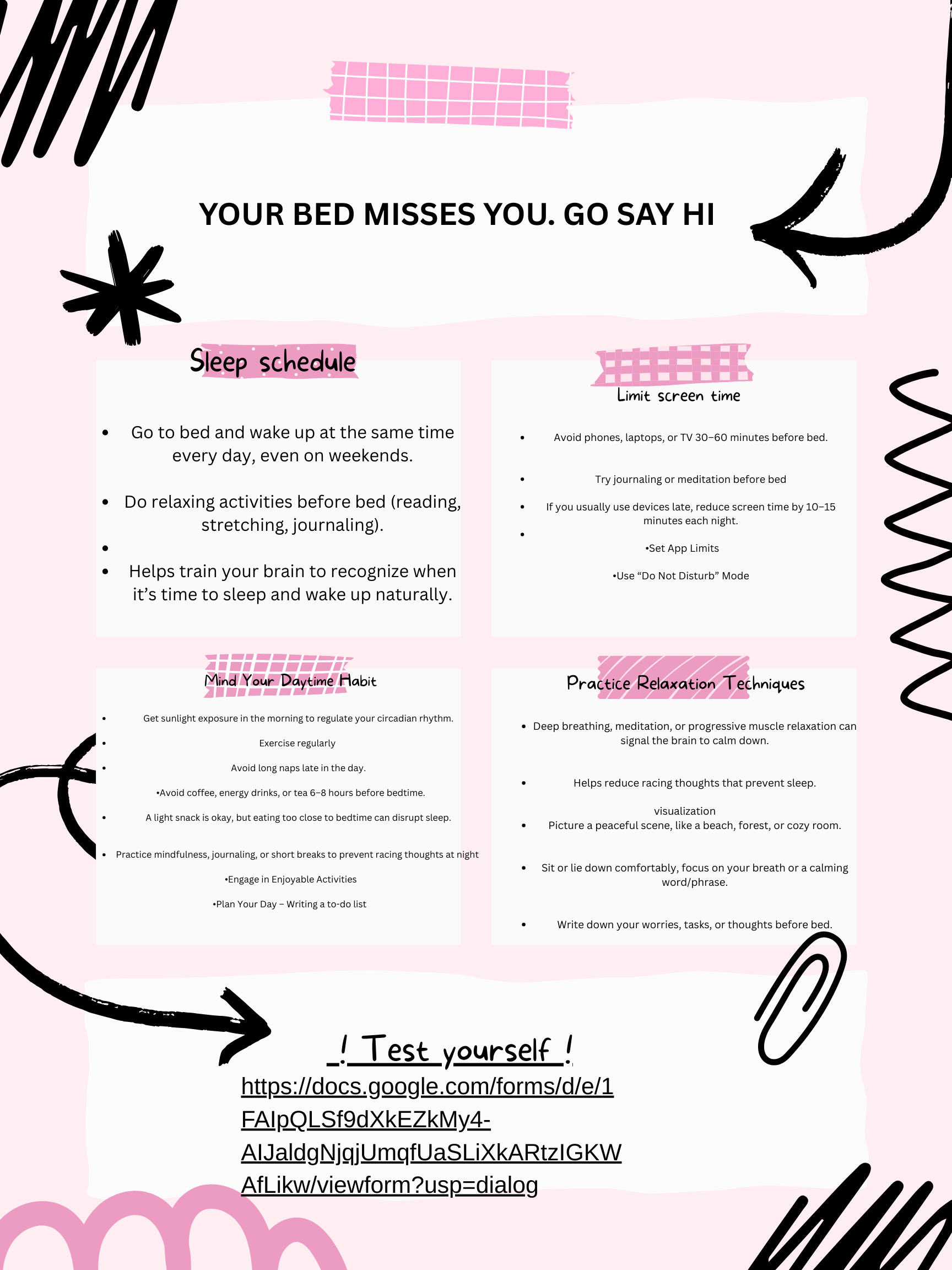
Google Link: https://docs.google.com/forms/d/e/1FAIpQLSf9dXkEZkMy4-AIJaldgNjqjUmqfUaSLiXkARtzIGKWAfLikw/viewform?usp=dialog
Draft 2 (600 words)
Name: Nancy Paulino Ovalle
Assignment 3
English:101
Title: Better Sleep, Better Grades
College students love coffee so much it might as well be an elective, who needs eight hours of sleep when you’ve got eight cups of caffeine ,right?
Prioritizing sleep isn’t lazy, it’s essential for mental health, learning and overall well being. Getting enough sleep each night helps you manage stress, remember information better, and perform your best in school and in life.Despite this, many students struggle to get sufficient rest due to late night studying, irregular schedules, and social or work commitments.This article will explore will explore three key areas: The challenges college students face, Why sleep matters for mental health and Physical health, and the Practical strategies to improve sleep habits. By understanding these areas ,students can make better choices to prioritize rest and take care of their mind and body.
Challenges College Students Face
Many college students struggle to get enough sleep, even though they know its importance .late nights studying ,irregular class schedules, part-time jobs ,social activities all contribute to chronic sleep deprivation, Based on the findings of this study ‘’Daytime sleepiness ,sleep deprivation, and irregular sleep schedules are highly prevalent among college students ,consequences can result in lower grade point average, increased risk of academic failure, compromised learning, impaired mood and increased risk of motor vehicles accidents’’. This shows that sleep deprivation is not just a minor convenience, it is a serious challenge that affects a student’s academic performance, mental health and overall well-being.Understanding these challenges is the first step towards making sleep a better priority
Why sleep matters for mental health and physical health
Sleep is essential because it gives your mind and body the power to fully recharge ,when you get a good night sleep, you stay focused, think clearly and keep your emotions in control, as well as your body uses the time to repair it self, it strengthens it’s immune system giving it the energy you need for the following day, According to Matthew Walker a neuroscientist ,professor and sleep expert at the University of Berkeley in his TED talk “sleep is your superpower” he emphasized that getting enough sleep improve brain functions such as memory, learning ,and handling emotions, he explains that sleeping both before and after learning helps your brain take in new information and hold onto it ,which also helps keep stress, anxiety,and irritability down. He also talks about how sleep affects your body,pointing out that even one night of poor sleep can make your immune cell system weaker by up to 70% and raising the chance of heart problems. These results show that sleep isn’t optional, it’s something our bodies and mind truly need. When we don’t get enough sleep we become more stressed, less focused and more likely to get sick, but when we do make sleep a priority we think more clearly, feel emotionally better and stay healthier overall.
Practical strategies to improve sleep habits
Practical strategies give people actionable ways to prioritize sleep, which improves both mental and physical health. Quality rest isn’t just about how many hours you sleep, but how you live throughout the day .These are habits or routines that are easy to apply in daily life. The Los Angeles Times article ‘’The Sleep Reset :How to Hack Your Circadian Rhythm for Better Health’’ focuses on the everyday strategies that helps better sleep , it explains why so many adults struggle with poor rest and it highlights how habits like screen time, hormonal changes , stress and irregular routines that disrupts the body’s natural sleep rhythm or circadian rhythm ,this article recommends practical strategies such as :
- Keeping a consistent sleep schedule.
- Creating a calming routine (meditating )
- Limiting Caffeine !!!
- Screen Time before bed
- Optimizing your bedroom environment (making your room as sleep friendly as possible so it’s easier for your body and mind to relax)
- Getting Morning Sunlight
- Managing stress
- Exercise
It emphasizes that better sleep comes from simple every day actions and a routine that supports your body’s natural sleep cycle.
Conclusion
Getting enough sleep is one of the simplest and most powerful ways college students can practice self care, even with busy schedules, late night studying, and stress , prioritizing sleep helps improve focus ,mood and overall health. Simple habits like keeping a regular sleep schedule ,winding down before bed, and setting up a relaxing bedroom can make a big difference. By treating sleep as a priority, students can protect their wellbeing and perform at their best every day.
Reference page
Academic source 1: Hershner, Shelley D, and Ronald D Chervin. “Causes and consequences of sleepiness among college students.” Nature and science of sleep vol. 6 73-84. 23 Jun. 2014, doi:10.2147/NSS.S62907
Media source 1: Matthew Walker TED Talk https://share.google/PwnDevOUQZpiiLUGN
Media source 2: The Los Angeles Time Article”The Sleep Reset: How To Hack Your Circadian Rhythm For Better Health.
Genre 1: Article
Genre 2: Poster
______________________________
Supporting documents like research notes, brainstorms, etc. (images are welcome)
______________________________
Complete assignment (750 words)
Name: Nancy Paulino Ovalle
Assignment 3
English:101
Title: Better Sleep, Better Grades
College students love coffee so much it might as well be an elective, who needs eight hours of sleep when you’ve got eight cups of caffeine ,right?
Prioritizing sleep isn’t lazy, it’s essential for mental health, learning and overall well being. Getting enough sleep each night helps you manage stress, remember information better, and perform your best in school and in life.Despite this, many students struggle to get sufficient rest due to late night studying, irregular schedules, and social or work commitments.This article will explore will explore three key areas: The challenges college students face, Why sleep matters for mental health and Physical health, and the Practical strategies to improve sleep habits. By understanding these areas ,students can make better choices to prioritize rest and take care of their mind and body.
Challenges College Students Face
Many college students struggle to get enough sleep despite knowing how important it is. Late-night studying, irregular class schedules, part-time jobs, and social activities all contribute to chronic sleep deprivation, Research shows that daytime sleepiness, sleep deprivation, and irregular sleep schedule are very common among college students and can lead to lower grade point average, impaired learning, increased risk of academic failure, mood problems and higher risk of motor vehicle accidents (Hershner and Chervin).This evidence shows that the lack of sleep is not just a minor inconvenience but a serious issue that affects student’s academic performance, mental health and overall well-being, Understanding theses effects is an important step towards encouraging students to prioritize better sleep habits.
Why sleep matters for mental health and physical health
Sleep is essential because it gives your mind and body the power to fully recharge ,when you get a good night sleep, you stay focused, think clearly and keep your emotions in control, as well as your body uses the time to repair it self, it strengthens it’s immune system giving it the energy you need for the following day, According to Matthew Walker a neuroscientist ,professor and sleep expert at the University of Berkeley in his TED talk “sleep is your superpower” he emphasized that getting enough sleep improve brain functions such as memory, learning ,and handling emotions, he explains that sleeping both before and after learning helps your brain take in new information and hold onto it ,which also helps keep stress, anxiety,and irritability down. He also talks about how sleep affects your body,pointing out that even one night of poor sleep can make your immune cell system weaker by up to 70% and raising the chance of heart problems. These results show that sleep isn’t optional, it’s something our bodies and mind truly need. When we don’t get enough sleep we become more stressed, less focused and more likely to get sick, but when we do make sleep a priority we think more clearly, feel emotionally better and stay healthier overall.
Practical strategies to improve sleep habits
Practical strategies give people actionable ways to prioritize sleep, which improves both mental and physical health. Quality rest isn’t just about how many hours you sleep, but how you live throughout the day .These are habits or routines that are easy to apply in daily life. The Los Angeles Times article ‘’The Sleep Reset :How to Hack Your Circadian Rhythm for Better Health’’ focuses on the everyday strategies that helps better sleep , it explains why so many adults struggle with poor rest and it highlights how habits like screen time, hormonal changes , stress and irregular routines that disrupts the body’s natural sleep rhythm or circadian rhythm ,this article recommends practical strategies such as :
- Keeping a consistent sleep schedule.
- Creating a calming routine (meditating )
- Limiting Caffeine !!!
- Screen Time before bed
- Optimizing your bedroom environment (making your room as sleep friendly as possible so it’s easier for your body and mind to relax)
- Getting Morning Sunlight
- Managing stress
- Exercise
It emphasizes that better sleep comes from simple every day actions and a routine that supports your body’s natural sleep cycle.
Conclusion
Getting enough sleep is one of the simplest and most powerful ways college students can practice self care, even with busy schedules, late night studying, and stress , prioritizing sleep helps improve focus ,mood and overall health. Simple habits like keeping a regular sleep schedule ,winding down before bed, and setting up a relaxing bedroom can make a big difference. By treating sleep as a priority, students can protect their wellbeing and perform at their best every day.
Reference page
Academic source 1: Hershner, Shelley D, and Ronald D Chervin. “Causes and consequences of sleepiness among college students.” Nature and science of sleep vol. 6 73-84. 23 Jun. 2014, doi:10.2147/NSS.S62907
Media source 1: Matthew Walker TED Talk https://share.google/PwnDevOUQZpiiLUGN
Media source 2: The Los Angeles Time Article ”The Sleep Reset : How To Hack Your Circadian Rhythm For Better Health.
genre 1: Article
Genre 2: Poster
Google Link:https://docs.google.com/forms/d/1cS_yozAMY0FvL3V8nI4tR9bYYwW5cUl50V0XjdpR-kU/edit

This entry is licensed under a Creative Commons Attribution-NonCommercial-ShareAlike 4.0 International license.

